As climate change intensifies, wildfires are becoming more frequent, destructive, and difficult to control. Project Blanket is a forward-thinking wildfire containment concept designed to help firefighters slow or stop the spread of fires before they reach critical ecosystems, communities, and infrastructure.
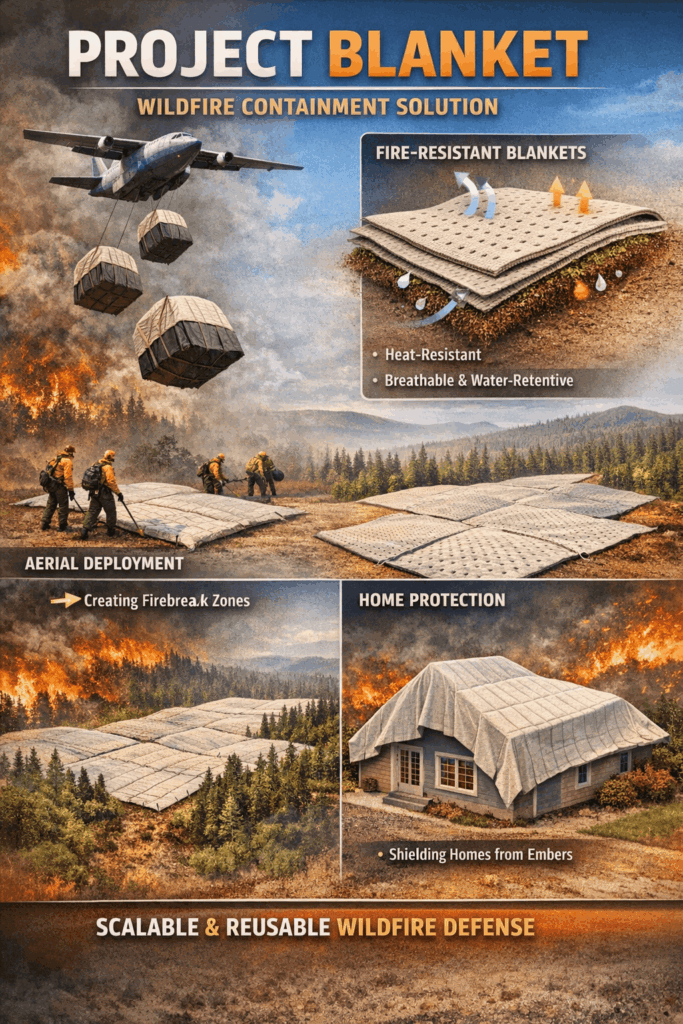
The system consists of a reusable, fire-resistant protective blanket engineered to create temporary fire barriers across vulnerable terrain. Constructed from advanced heat-resistant materials, the blanket is designed to withstand extreme temperatures while incorporating breathable perforations that allow vegetation and soil to maintain airflow and retain natural moisture. Integrated water-retention fibers help keep the protected area damp, further reducing ignition risk.
To support rapid emergency response, Project Blanket is designed for fast aerial deployment. Blankets can be air-dropped into strategic locations and quickly secured by fire jumpers or ground crews, enabling responders to establish containment lines in areas that are difficult to access using traditional firefighting equipment.
The modular system allows individual blankets to interconnect and scale, forming large protective zones capable of shielding forests, wildlife habitats, critical infrastructure, and entire communities. After a fire event, the blankets can be recovered, inspected, and redeployed, making the solution both sustainable and cost-effective.
In addition to large-scale wildfire containment, Project Blanket is also being explored for residential protection. Specialized versions could be designed for homeowners in wildfire-prone regions, allowing houses, roofs, decks, and surrounding vegetation to be temporarily covered with fire-resistant protective layers. These residential blankets could help reduce ember ignition and radiant heat exposure, providing an additional layer of protection for homes during wildfire emergencies.
Through this approach, Project Blanket aims to complement existing firefighting strategies by providing a flexible, scalable, and reusable protection system that helps slow wildfire progression while safeguarding natural landscapes and residential communities
Each year, millions of tons of used coffee grounds are discarded globally, most of which end up in landfills where they contribute to methane emissions and unnecessary organic waste. Project Grounds is a circular sustainability initiative focused on transforming coffee waste into valuable agricultural resources.
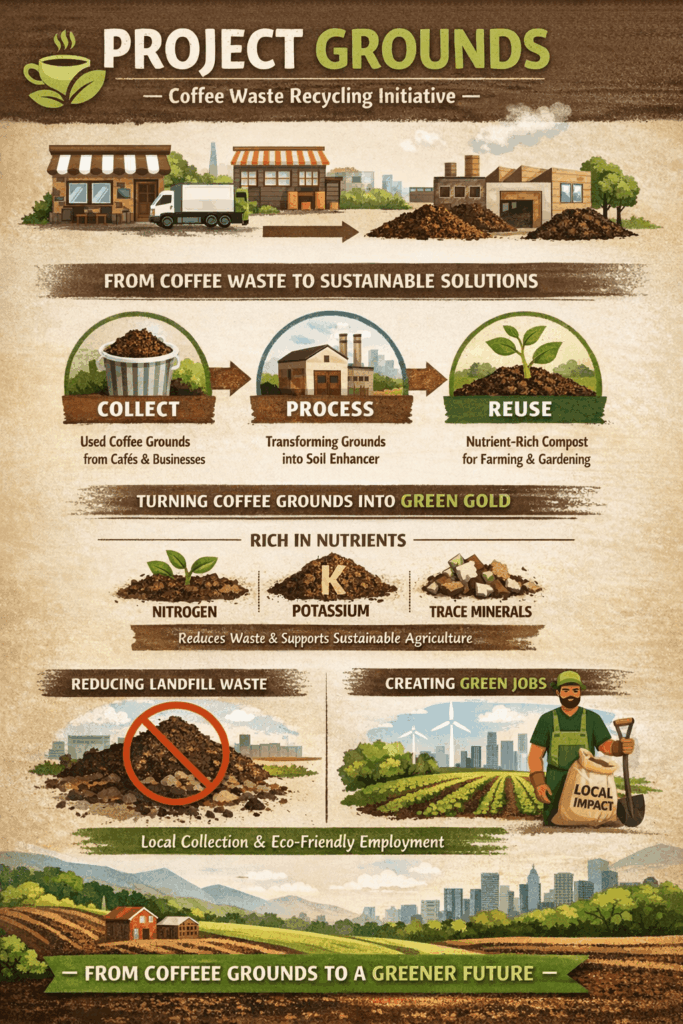
The project collects used coffee grounds from cafés, restaurants, offices, and commercial coffee producers, diverting organic waste from landfills and giving it a second life. Through a specialized processing method, the grounds are blended with natural materials such as straw and other plant fibers to improve aeration and prevent clumping. The resulting mixture creates a nutrient-rich soil enhancer suitable for agriculture, landscaping, and home gardening.
Coffee grounds naturally contain beneficial nutrients such as nitrogen, potassium, and trace minerals, making them an ideal additive for improving soil health and supporting sustainable growing practices. By converting coffee waste into a productive soil amendment, Project Grounds helps reduce landfill waste while contributing to healthier ecosystems.
Beyond its environmental benefits, the initiative also supports local economic development. Collection, processing, and distribution networks can be established in urban centers around the world, creating new green jobs while helping cities manage organic waste more effectively.
Project Grounds demonstrates how everyday waste streams can be transformed into practical, scalable solutions that support circular economies, sustainable agriculture, and cleaner cities.
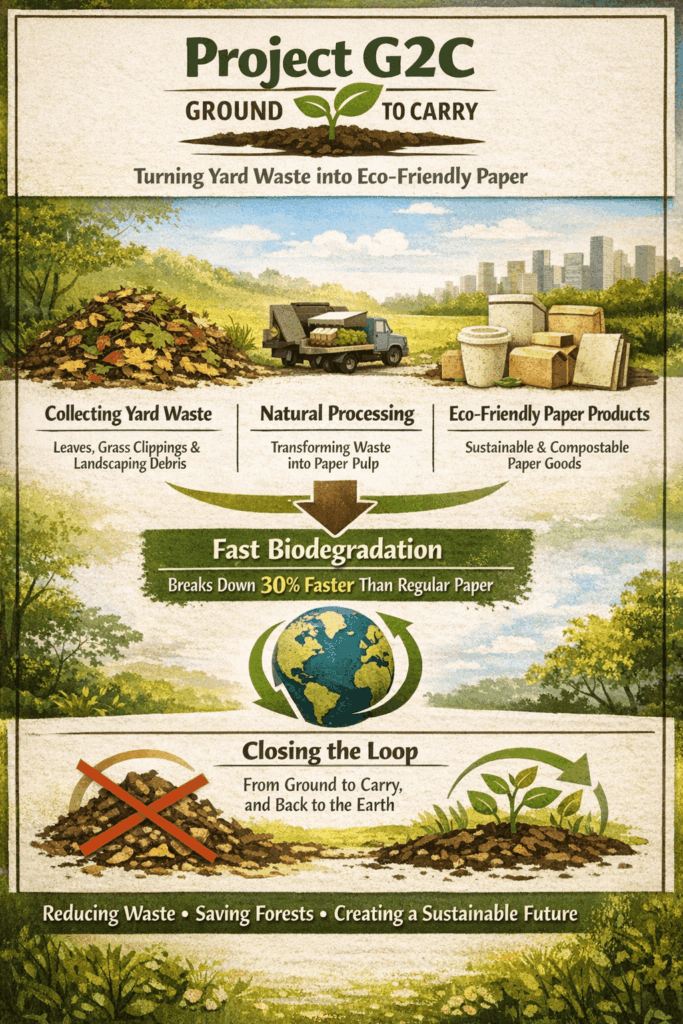
The initiative focuses on converting discarded leaves and grass clippings into biodegradable paper materials through an entirely natural processing method. By repurposing these organic fibers, G2C reduces reliance on traditional wood-based pulp while giving new value to materials that would otherwise be treated as waste.
The resulting paper products are designed to decompose significantly faster—up to 30% quicker than conventional paper—while remaining completely organic and environmentally safe. This makes them ideal for packaging, disposable goods, and other short-life paper products where rapid biodegradability is beneficial.
Beyond reducing landfill waste, Project G2C supports a circular resource system where organic materials collected from the ground are transformed into practical everyday products that eventually return safely to the earth.
Through this approach, Ground to Carry aims to help cities, landscaping companies, and communities turn routine yard waste into a renewable material stream that supports sustainable manufacturing and reduces pressure on forests
© Macro Tier Holdings 2026 | All Rights Reserved